Frozen and Burst Pipes in Lexington: Prevention, Warning Signs, and What to Do First
October 13, 2026
Read more
Hard water and taste issues are common in Lexington. Here's what's in your water, what filtration options exist, and how to choose the right system.
Most Lexington homeowners do not think much about their water until something changes. The taste gets worse. There is a film on the shower door that will not wipe off. The coffee maker needs descaling every few weeks. The skin feels dry after a shower. These are not random annoyances. They are the water telling you something about what is in it. Wildcat Leak Detection installs and services custom water filtration systems for homes throughout Lexington, Georgetown, Frankfort, and surrounding Central Kentucky communities, and this guide covers what you need to know before deciding whether a filtration system makes sense for your home.
Lexington-Fayette Urban County gets its water from Kentucky River sources treated by Kentucky American Water. The water is safe to drink by EPA standards, but safe and ideal are not the same thing. Central Kentucky's water supply has a few characteristics that affect how the water performs in your home day to day.
Hardness is the most significant one. Kentucky sits on limestone bedrock, and water that moves through limestone picks up calcium and magnesium along the way. Lexington's water consistently measures in the hard to very hard range, typically between 150 and 200 parts per million. Hard water is not a health risk, but it has real consequences for your home. Scale builds up inside water heaters, pipes, and appliances. Soap does not lather as efficiently, which means you use more of it. Dishes come out of the dishwasher with spots. Fixtures develop a white crust that requires regular scrubbing.
Chlorine and chloramines are added during treatment to disinfect the water supply. They do their job, but they also affect taste and odor. Many Lexington homeowners notice a faint chemical smell or taste, particularly when the water is first drawn from the tap.
Sediment and particulates can enter the water at various points between the treatment plant and your tap, particularly in older neighborhoods with aging distribution infrastructure. Fine sediment affects water clarity and can accumulate in appliance inlets and aerators over time.
None of this means Lexington's water is bad. It means a targeted filtration system can meaningfully improve what comes out of your taps, protect your plumbing and appliances, and give you confidence in the water your family uses every day.
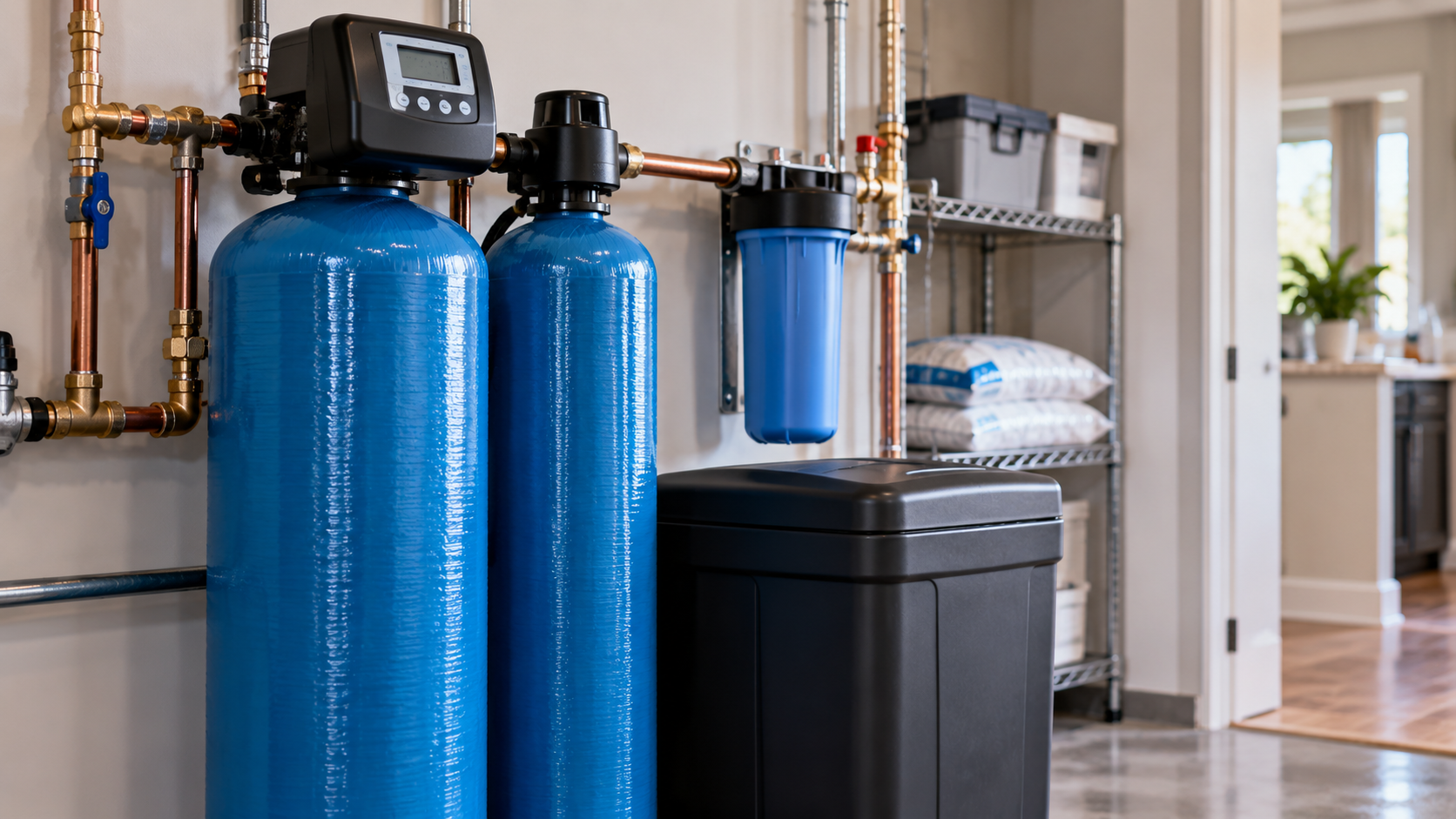
A water softener addresses hardness specifically. It uses an ion exchange process that replaces the calcium and magnesium ions responsible for hardness with sodium ions, producing softened water throughout the entire house. Every tap, every appliance, and every shower gets the softened water.
The benefits for a Lexington home are substantial. Scale stops building up in your water heater, which operates more efficiently and lasts longer. Soap and detergent lather better, so you use less. Fixtures stay cleaner. Skin and hair feel noticeably different after switching from hard to soft water, a difference most households comment on within the first week.
The tradeoff is that softened water has a slightly elevated sodium content, which some people prefer not to drink. Many households install a softener for the whole home and a separate reverse osmosis filter at the kitchen sink for drinking and cooking water.
Salt-free water conditioners are an alternative to traditional salt-based softeners. They do not remove minerals from the water but change their structure so they do not form scale the same way. They require no salt, no backwashing, and no regeneration cycle. The results are different from a traditional softener but meaningful for scale prevention.
A whole-home carbon filter addresses chlorine, chloramines, and organic compounds that affect taste and odor. Activated carbon has an enormous surface area that traps these compounds as water passes through. The result is water that tastes cleaner and has no chemical smell throughout the entire house, including the shower, where chlorine vapor is a real consideration for people who are sensitive to it.
Carbon filtration does not address hardness. For homes where both scale and taste are concerns, a combination system that includes both softening and carbon filtration is common.
Reverse osmosis (RO) is the most thorough filtration method available for residential use. Water is pushed through a semi-permeable membrane that blocks the vast majority of dissolved solids, including minerals, heavy metals, nitrates, and other contaminants. The output is exceptionally pure water with neutral taste.
RO systems are most commonly installed at a single point of use, typically under the kitchen sink, with a dedicated tap for drinking and cooking water. Whole-home RO systems exist but are significantly more expensive and create a wastewater stream that most residential applications do not justify.
For Lexington homeowners who want the best possible drinking water quality, a point-of-use RO system paired with a whole-home softener or carbon filter is the most comprehensive approach.
A sediment filter is often the first stage in a multi-stage filtration system. It removes particulate matter including sand, silt, rust, and other debris before the water reaches finer filtration stages or appliances. Homes in older Lexington neighborhoods with aging supply infrastructure often benefit most from sediment filtration, which also protects downstream equipment from particulate damage.
UV purification uses ultraviolet light to neutralize bacteria, viruses, and other biological contaminants without adding chemicals to the water. It is not typically necessary for homes on Lexington's treated municipal supply, but it is a common addition for homes with a well water source, where biological contamination is a more realistic concern.
The right system depends on what your water actually contains and what problems you are trying to solve. Starting with a water test is the most useful first step. A water quality test tells you the hardness level, pH, chlorine content, and whether any other contaminants are present above normal levels. That information determines which filtration approach makes the most sense and avoids over-engineering a solution for problems that do not actually exist.
For most Lexington homeowners on city water, the primary concerns are hardness and taste. A water softener paired with a carbon filter or a point-of-use RO system for drinking water addresses both and covers the most common complaints.
For homes with well water, the calculus is different. Well water bypasses municipal treatment entirely, which means biological contamination, iron, hydrogen sulfide, and other contaminants that are rare on city water become real considerations. A well water filtration system typically involves multiple stages including sediment filtration, iron removal, softening, and UV purification.
Wildcat Leak Detection designs and installs water filtration systems sized and configured for your home's specific water supply and usage patterns. The process starts with understanding what you want to address and what your household's daily water demand looks like. System sizing matters. An undersized softener regenerates too frequently and adds unnecessary operating cost. An oversized system is an unnecessary upfront expense.
Whole-home systems are installed at the point where the water supply enters the house, typically near the water meter or in a utility room. The installation involves connecting the system into the supply line, configuring the regeneration or backwash cycle if applicable, and verifying proper flow and performance before completion.
Point-of-use systems like under-sink RO filters are installed at the specific location, with a dedicated faucet added to the sink for filtered water. Installation is less involved than a whole-home system but still benefits from professional installation to ensure the membrane is properly seated and the connections are watertight.
Most whole-home system installations can be completed in a single visit. We provide a clear picture of what the system involves and what ongoing maintenance looks like before any work begins.
Water filtration systems are low-maintenance compared to what they protect, but they do require periodic attention.
Salt-based softeners need the salt tank refilled on a regular schedule. The frequency depends on household size and water hardness. Most Lexington households refill every 4 to 8 weeks. The resin bed should be cleaned periodically and eventually replaced, typically every 10 to 15 years.
Carbon filters have a media life that depends on usage and the concentration of contaminants being removed. Whole-home carbon filters typically need media replacement every 3 to 5 years.
RO membranes need replacement every 2 to 3 years under normal use, with pre-filters replaced annually. Most under-sink RO systems include a filter replacement reminder schedule.
Sediment filters need cartridge replacement every 3 to 6 months depending on the particulate load in your water.
Wildcat Leak Detection provides maintenance service for installed filtration systems throughout the Lexington area.
Yes. Lexington's municipal water meets EPA Safe Drinking Water Act standards and is tested regularly. A filtration system improves taste, reduces hardness effects, and can address specific concerns, but it is an enhancement rather than a necessity for most city water customers.
The clearest signs are scale buildup on faucets and shower doors, spots on dishes after washing, shortened water heater life, and soap that does not lather well. A water hardness test confirms the exact hardness level and helps determine whether a softener is the right solution and what size makes sense for your home.
Softened water contains slightly elevated sodium levels because of the ion exchange process, but the amount is small enough that most people do not detect a taste difference. Households concerned about sodium intake typically add a reverse osmosis filter at the kitchen sink, which removes sodium along with other dissolved solids for drinking and cooking water.
A properly sized and maintained water softener typically lasts 15 to 20 years. Lexington's moderately high water hardness puts more demand on the resin bed than softer water areas would, making proper sizing and regular salt maintenance more important for maximizing the system's lifespan.
Yes. We service and maintain water filtration systems regardless of who installed them throughout Lexington, Georgetown, Frankfort, and surrounding Central Kentucky communities. Call (502) 300-5060 to schedule a service visit.
Wildcat Leak Detection designs, installs, and maintains custom water filtration systems for homeowners throughout Lexington, Georgetown, Frankfort, and surrounding Central Kentucky communities. Whether you are dealing with hard water scale, taste and odor issues, or want the most thorough filtration available for your drinking water, our certified team can help you find the right solution. Call (502) 300-5060 or request a free estimate online to get started.